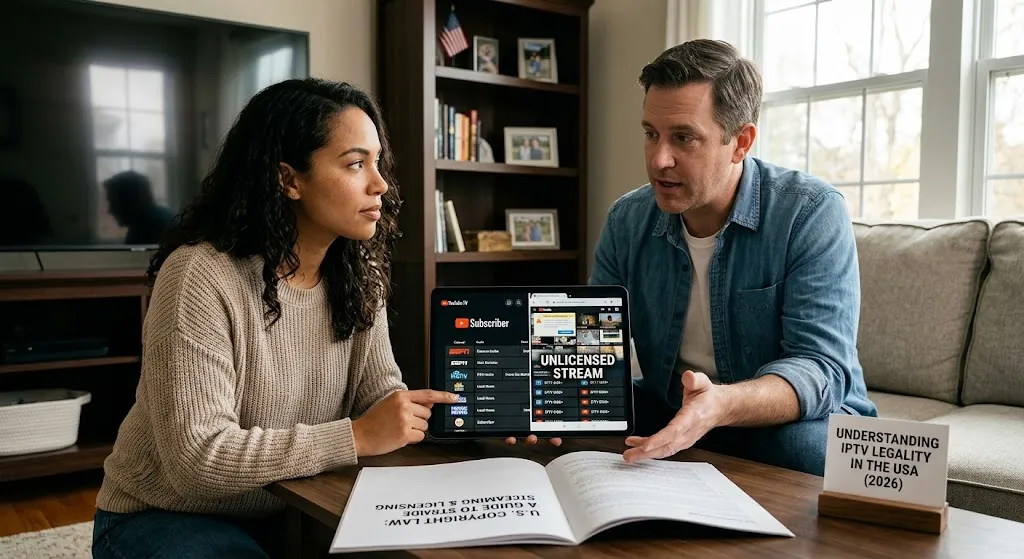
IPTV itself is completely legal in the United States. It's a method of sending television over the internet, the same underlying technology that Netflix, Hulu and YouTube TV use every day. Nobody is coming after you for using an app that streams video over IP. What gets complicated isn't the technology, it's the content behind it. Whether a specific IPTV service is legal comes down to whether that provider actually has the rights to the channels it's selling, and that's the part worth understanding before you hand over your card details.
IPTV is a delivery method, not a content type
IPTV stands for Internet Protocol Television. It just means TV delivered through an internet connection instead of a satellite dish or a cable line. Legally, that's no different from any other kind of internet streaming. The law doesn't care how content reaches your screen. It cares about whether whoever is sending it had permission to do so. A cable company, a licensed streaming app and an IPTV provider can technically deliver the exact same channel; only one of them needs to have paid for the right to carry it.
This is why the question "is IPTV legal" doesn't really have a single yes or no answer, and why people searching for a legal IPTV service in the USA often get mixed replies. It's closer to asking "is email legal". Email itself is just a protocol for sending messages, and nobody would say it's illegal, even though it can obviously be used for scams. IPTV works the same way: the protocol is neutral, and what matters is who's using it and what they're sending through it.
Where things actually go wrong
Problems start when a provider streams channels it never licensed. Cable networks, sports leagues and broadcasters sell the rights to show their content, and a legitimate streaming service pays for those rights, the same way Hulu or YouTube TV do. Some IPTV sellers skip that step entirely and resell channels they have no rights to, usually at a fraction of the normal cost. That's copyright infringement, and in the US it falls under the Digital Millennium Copyright Act, better known as the DMCA.
Under the DMCA, distributing copyrighted content without a license can carry civil penalties of up to $150,000 per work for willful infringement, and in serious commercial cases, criminal charges with fines reaching $250,000 and up to five years in prison for a first offense. Those numbers are aimed at the businesses running large-scale piracy operations, not someone watching TV at home, but they show how seriously US law treats unlicensed content distribution.
How anti-piracy enforcement actually works
Most of the pressure on illegal IPTV comes from an organization called ACE, the Alliance for Creativity and Entertainment, a coalition backed by major Hollywood studios, broadcasters and streaming platforms. ACE investigates pirate IPTV operations, works with hosting providers and domain registrars to take services offline, and refers the largest cases for criminal prosecution. Some of the operations shut down this way have had hundreds of thousands of paying subscribers before they disappeared overnight, which is usually the first sign to customers that anything was wrong in the first place.
Payment processors play a role too. Once a card network or processor identifies a merchant as running an unlicensed streaming service, they'll often cut off payment processing, which is a second common reason logins suddenly stop working with no explanation.
What the FCC actually regulates
Legitimate IPTV providers in the US that offer live TV packages typically register as virtual multichannel video programming distributors, or vMVPDs, which puts them under a form of FCC oversight and requires proper licensing agreements with content owners. This is the same category services like Hulu + Live TV and YouTube TV fall into. A seller advertising thousands of live channels for a few dollars a year, with no clear business information anywhere on their site, isn't operating in that same category, and usually isn't registered as anything at all.
What about "fully loaded" streaming boxes?
You'll sometimes see Android boxes or Fire Sticks sold as "fully loaded" or "jailbroken", pre-installed with apps set up to access pirated content out of the box. Selling hardware specifically configured this way is treated more seriously under US law than simply using a streaming app, because it's marketed and sold with the explicit purpose of enabling infringement. So the question "are IPTV boxes legal" really depends on how the box is set up and sold. Sellers of these boxes have faced lawsuits and criminal charges in the past. Buying a plain, unmodified streaming device like a genuine Fire TV Stick and installing your own legitimate apps doesn't carry that same risk.
How to spot a legitimate IPTV service
A few things are worth checking before you subscribe to anything, and none of them require any legal knowledge, just a bit of common sense.
- Local channels are explained. If a service advertises US local channels, it's fair to ask how it's licensed to carry them. A clear answer is a good sign, and a vague one is not.
- The pricing is realistic. Genuine content licensing costs money, so a service dramatically cheaper than cable for the same channels, or selling a full year of thousands of channels for the price of one takeaway meal, should raise a question.
- They're upfront about what they offer, with a real website, clear plan details and pricing, instead of hiding behind vague marketing or contact-only-on-Telegram setups.
- Support and terms are easy to find, including a real way to reach them and clear information about plans, renewals and refunds.
- They don't tell you to hide what you're doing. If a seller specifically suggests using a VPN "just in case" before you've even asked, treat that as a signal worth paying attention to.
What happens if you use a service that turns out to be illegal
For most individual subscribers, the practical risk isn't a lawsuit, it's disruption. Illegal IPTV operations get shut down fairly often, sometimes overnight, which means you lose access with no warning and, almost always, no refund. Because these services often change servers, domains and payment methods to stay ahead of enforcement, quality and reliability tend to be inconsistent even while they're still running. If you want a service you can actually rely on month to month, that stability matters just as much as the price.
There's also a simple cost comparison worth making. A legitimate IPTV subscription in the US typically runs somewhere between $15 and $25 a month, which is already well below the average cable bill. A provider promising the same channel count for a fraction of that price isn't just being generous. Content licensing has a real cost, and a price that low usually means that cost was skipped entirely rather than passed on to you as a discount.
Does this apply outside the US too
The same basic principle holds in most places: IPTV as a technology is fine, licensing is what determines legality. If you're comparing options elsewhere, we've got dedicated guides for IPTV in the UK and IPTV in Canada covering what to look for in each of those markets specifically.
If you're comparing providers, our guide to the best IPTV subscription worldwide covers uptime, support and pricing, and our explainer on the IPTV portal URL helps once you're ready to set up.
None of this is legal advice, just a plain explanation of how the law generally treats IPTV in the US. If you're unsure about a specific provider, the questions above are a reasonable place to start, and it's always worth a quick search for the provider's name plus "reviews" before you commit to a longer plan.
If you'd rather skip the guesswork, we offer an IPTV subscription in the USA with transparent pricing, clear terms and a free trial, so you can see exactly what you're getting before committing to a plan.